

Bill rate is what the client pays your agency for an hour of work. Pay rate is what the worker actually receives. The gap between the two isn’t profit sitting in a drawer. It covers payroll burden, overheads, and margin, and the standard formula is bill rate = pay rate + burden + overhead + margin. Bill rate is almost always the bigger number, and it’s the figure that appears on the invoice.
Recgenie
Keep Accurate Rates on Track
RecGenie brings timesheets and expenses together, helping recruitment agencies address delayed approvals and cumbersome processes.
A bill rate is the hourly (or daily) figure a staffing agency charges a client for a worker’s time. The agency sets it, usually after negotiating with the client and checking it against the pay rate the worker will actually accept. Get this number wrong and you’re either pricing yourself out of the deal or quietly funding the placement out of your own margin.
Every properly built bill rate includes three components:
The Deel glossary on bill rate frames this well: bill rate isn’t a markup slapped onto pay for the sake of it, it’s pay rate plus every legally mandated cost, plus overhead, plus the profit that keeps the lights on. There are two ways to express the formula, and both land on the same number:
Additive form: Bill rate = Pay rate + Burden + Overhead + Margin
Multiplicative form: Bill rate = Pay rate × (1 + Markup %)
Here’s a worked example. A contractor’s pay rate is $30/hour. Burden runs at 25% of pay ($7.50). Overhead allocation adds $2.50 per billable hour. The agency wants a margin per hour. Add those together: $30 + $7.50 + $2.50 + the margin equals the bill rate. Expressed as a multiplier, the bill rate is higher than the pay rate. Deltek’s worked comparisons show the same mechanics: bill rate is consistently higher than pay rate once burden and overhead are properly accounted for, not just when margin is added.
Pay rate is the amount a worker is contracted to receive for their labour, before any deductions and before the agency’s costs enter the picture. It’s what shows up on the worker’s payslip line, not what the agency spends to employ them. QuickBooks draws this distinction clearly: pay rate, cost rate, and billable rate are three separate figures, and treating any two of them as interchangeable is where most rate-setting errors start.
Pay rate comes in a few common formats:
The critical point recruiters sometimes miss: pay rate excludes employer burden entirely. It’s not “what the worker costs the business,” it’s “what the worker is owed.” Confusing the two is how agencies end up billing clients too little to cover their own obligations, particularly around statutory contributions covered under Social Security Administration guidance and FLSA rules on hourly versus salaried classification.
Converting between formats is simple arithmetic once you know the annual working hours. A $62,400 salary divided by 2,080 standard working hours a year gives an hourly pay rate of $30. Run it the other way: a $30/hour rate multiplied by 2,080 hours gives the same $62,400 annual figure. Where it gets tricky is when a salaried worker’s actual hours vary week to week. That’s when a proper hourly conversion, not a rough annual divide, protects both the worker’s pay and the agency’s bill rate calculation.
Getting from pay rate to bill rate isn’t guesswork, it’s a build-up of known costs plus a deliberate margin decision. Skip a step and the shortfall comes straight out of the agency’s pocket.
Here’s the sequence:
payroll burden typically runs 18% to 35% of pay rate, depending on role, jurisdiction, and whether benefits like health cover are included. A specialist role with enhanced benefits sits at the top of that range; a straightforward temp placement in a low-burden jurisdiction sits near the bottom.
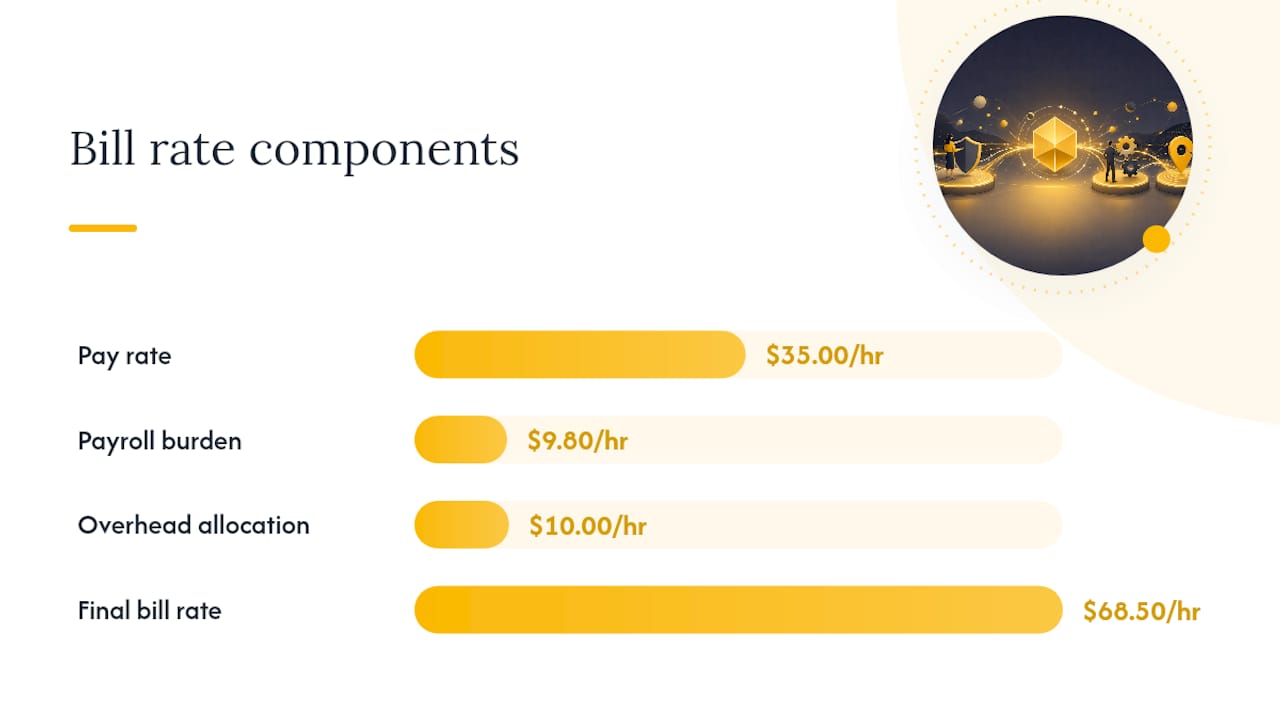
Worked example: pay rate is $35/hour. Burden at 28% adds $9.80. Overhead allocation, based on $150,000 in annual fixed costs spread across 15,000 billable hours, adds $10 per hour. The agency wants a 20% margin on the final bill rate, not just on pay. Using the markup formula gets messy here, so work margin-first: if margin must be 20% of bill rate, then pay plus burden plus overhead (54.80) must equal 80% of bill rate. Divide 54.80 by 0.8, and the bill rate comes out at $68.50/hour.
That last step trips up a lot of people. Markup on cost and margin on price are not the same calculation, and mixing them up is one of the fastest ways to underquote a client without realising it until the invoices stop covering payroll.
Most staffing agencies work within a fairly narrow band of multipliers, and knowing where you sit in that band tells you whether your pricing is competitive or unsustainable.
across the sector, markups commonly range from roughly 30% to 65% above pay rate, while burden alone typically consumes 18% to 35% of pay. A markup at the low end of that spread with high burden leaves almost no room for margin.
Seniority and skill scarcity shift these numbers more than most rate cards admit. A junior administrative temp with low burden and plentiful supply might sit at a 1.3× multiplier and still deliver a healthy margin, because overhead per hour is low and the client accepts a standard rate. A senior data engineer with enhanced benefits, higher burden, and only a handful of qualified candidates in the market often needs a 1.6× multiplier or more just to break even on margin, let alone hit target profitability.
Industry gross-margin targets vary by segment, but the pattern holds everywhere: the further a role sits from “commodity temp work,” the more the bill rate needs to flex upward, not because the agency is charging more for the sake of it, but because burden, overhead allocation, and competitive pay pressure all rise together. Treating every placement with the same multiplier is one of the quieter ways agencies erode margin on their best (and hardest-won) contracts.
Calculating a single bill rate is one thing. Setting rates that hold up across a full book of placements, where utilisation dips and clients push back on price, is a different discipline.
Pro Tip: Set a hard floor bill rate for every role category before you start quoting clients, and refuse to go below it in negotiation. It’s far easier to hold a line than to claw back margin after a contract’s signed.
Two safeguards are worth building into standard practice: rate-review clauses that trigger automatically at set intervals (quarterly or annually, depending on contract length), and a simple internal rule that no placement goes live without the minimum viable bill rate signed off first. Both cost nothing to implement and save agencies from the slow, invisible erosion that comes from pricing on gut feel.
A handful of errors show up again and again in agency rate-setting, and most of them trace back to treating one number as if it were another.
Each of these is fixable with a five-minute check before a contract goes out, not a system overhaul. The discipline is in remembering to run the check every time, not just the first time.
Three scenarios cover most of what recruiters actually price day to day.
Scenario A: hourly temp placement. Pay rate $22/hour, burden 20% ($4.40), overhead $2/hour, target margin $6/hour. Bill rate: $34.40/hour, a multiplier of roughly 1.56×.
Scenario B: salaried consultant billed hourly. Annual salary $85,000, converted at 2,080 hours gives a pay rate of $40.87/hour. Bill rate: $69.13/hour.
Scenario C: High-burden specialist billed hourly.
Bill rate: $95.25/hour. That’s the kind of movement that makes burden estimation worth getting right, not rounding.
A reusable spreadsheet needs five input fields per role: confirmed pay rate, burden percentage, overhead per billable hour, target margin (specify markup or margin basis), and expected utilisation percentage. Feed those five numbers in consistently across every placement, and the bill rate calculates itself. Skip even one, and you’re back to guessing.

Every formula above assumes you know exactly how many hours were worked. In practice, late or missing timesheets quietly understate utilisation and let billable hours slip through unbilled, which erodes the margin you calculated on paper.
Disputes over hours or expenses slow invoicing and strain client relationships, and unified systems that capture both in one place reduce that friction. A password-free approval process and combined timesheet and expense handling can help close that gap, cutting the delay between hours worked and invoices sent. The tighter that loop, the more reliably your calculated bill rate turns into actual billed revenue.
Recruiters who’ve nailed their bill rate formula still lose margin if the hours behind it aren’t captured properly. RecGenie exists for that exact gap between a correct rate calculation and an invoice that actually reflects it. Its timesheet software removes the password-protected approval bottlenecks that delay sign-off, and its unified handling of timesheets and expenses means fewer disputes over what’s owed and faster turnaround from hours worked to cash collected.
For an agency juggling multiple client contracts and pay structures, that consolidation matters more than another spreadsheet tab. Reporting tools built into the platform give a live read on utilisation and billable hours, the exact inputs your bill rate calculation depends on. If your current process still relies on chasing signatures or reconciling two separate systems for time and expenses, book a demo and see how much of that leakage is fixable.